Winter presents serious operational risks for warehouses and logistics facilities. While icy yards and delayed deliveries are visible challenges, the greater threat often develops quietly inside the building envelope. Frost damage can disrupt operations, destroy stock, and trigger significant insurance claims.
Maintaining consistent internal temperatures is essential to prevent freezing conditions that compromise both infrastructure and stored goods. As explained in Powrmatic’s guidance on warehouse frost protection, temperature control is one of the most effective ways to reduce freeze-related building damage.
What Frost Risk Looks Like in Warehousing
Frost damage in commercial and industrial buildings commonly occurs when internal temperatures are lowered to reduce energy costs during prolonged cold weather. Extended sub-zero conditions place stress on building services, particularly pipework located in external walls, roof voids, unheated zones, or poorly insulated areas. When water inside these systems freezes, it expands and can cause pipes to crack or burst. In particularly severe winters, even underground services may be vulnerable if insulation is inadequate. Maintaining safe background temperatures while balancing energy efficiency is essential to preventing costly frost-related damage.
In logistics environments, frost risk typically develops in:
- Perimeter walls and poorly insulated sections
- Loading docks and shutter door openings
- Roof voids and high-bay racking areas
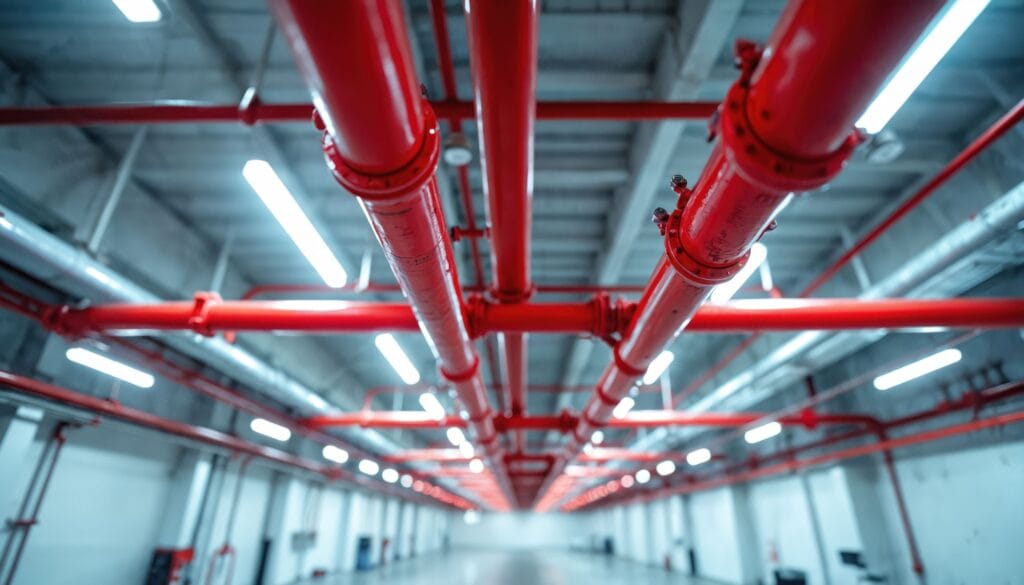
- Exposed sprinkler and plumbing systems
For warehouses, this can mean:
- Stock contamination or destruction
- Damage to conveyors, scanners, and automation systems
- Structural repair costs
- Extended operational downtime
The Financial Impact: What the Data Shows
The financial consequences of frozen pipes are substantial.
Research into commercial insurance trends shows that escape of water is one of the most financially damaging claim types for businesses, driven in part by freezing pipe failures and winter weather effects. In the UK, commercial weather-related claims (including escape of water) were a substantial part of property insurance payouts in recent years. Insurers paid out around £443 million in weather damage claims to businesses in 2023 alone, with freeze-related burst pipes contributing significantly during cold periods.
More broadly, commercial insurers consistently rank “escape of water” incidents among the most costly property risks. Marsh Commercial discusses these winter property risks in detail.
For logistics operators, the true cost often extends beyond repair bills. Business interruption losses — including missed delivery windows, contractual penalties, and reputational damage — can easily exceed the cost of physical damage repairs.
Effective Climate Control: Air Rotation
Heating alone does not eliminate frost risk. In large warehouse spaces, warm air rises and becomes trapped at roof level, leaving colder air near floors and perimeter walls. This temperature stratification creates localised cold spots where freezing can still occur.
Air rotation systems help address this issue by continuously circulating air throughout the building, balancing temperature differences and reducing freeze points. Air Rotation controls air movement improves temperature consistency across large warehouse volumes.

Designed to control climate efficiently in large, open spaces using a minimal number of units, Air Rotation systems remove the need for extensive ductwork and can be installed internally or externally to suit site constraints. Suitable for both new-build and existing facilities, Air Rotation provides dependable frost protection without complex infrastructure.
Importantly, when used purely for frost protection, the system will only activate if temperatures fall toward critical levels — meaning in the majority of cases it will not need to operate continuously, helping to minimise energy use and operating costs.

While traditional systems operate on gas, our advanced AirRoteX technology now incorporates electric and gas hybrid options, delivering enhanced performance, improved energy efficiency, and greater flexibility to meet modern sustainability and operational requirements. Where gas-fired systems are used solely for frost protection, they may also be exempt from inclusion within commercial EPC energy assessments, providing an additional compliance advantage.
By preventing stagnant cold zones, steady air circulation quietly ensures that vulnerable systems — from pipes to stored goods — remain safely above freezing without excessive energy use.
Insurance Considerations: Why Prevention Matters
Frost protection is not only an engineering priority; it directly affects insurance outcomes.
Most commercial property policies require businesses to take “reasonable precautions” to prevent foreseeable damage. Failure to maintain heating systems, protect pipework, or monitor low temperatures during cold spells can complicate claims.
Businesses should review:
- Property damage limits
- Business interruption indemnity periods
- Escape of water deductibles
- Sprinkler warranties and impairment procedures
Demonstrating documented maintenance, temperature monitoring, and winter preparedness planning strengthens both risk management and insurer confidence at renewal.
Conclusion
Frost protection in warehousing and logistics is far more than a seasonal comfort measure. It is a business continuity safeguard, a financial protection strategy, and an essential part of insurance risk management.
With documented claims running into tens of millions of pounds during cold periods, proactive frost prevention — supported by temperature control and effective air rotation — is not simply advisable. It is commercially essential.
To strengthen your winter resilience, complete the form below to arrange a free Air Rotation frost protection site survey tailored to your warehouse environment, or to book onto our CIBSE-approved CPD seminar, “Optimising Climate Control in Warehousing & Logistics with Air Rotation.” Our specialists will help you identify cold-risk areas, improve temperature consistency, and implement an efficient, compliant climate control strategy designed specifically for large-volume logistics spaces.